
“So, uh, I’ve started a blog again,” I said. “The audience is old friends who met me through online journaling and chat rooms.” (I didn’t want to explain what distinguished a talker from other forms of chat rooms, but I thought fondly of lively conversations on Somewhere Else and Cirrus Nebula.)
“That’s good!”
“I may write about you. Nothing too personal, definitely nothing intimate. But I can’t think of a good pseudonym for you. And you will likely appear in parts of my life I want to write about, so…”
“This is for your friends?”
“I have no plans or illusions about amassing tons of followers.”
“Just use Mitch,” he said, easily solving the dilemma I had created.
Mitch and I were having dinner at the counter of Little Goat Diner, our current favorite place to eat before and after seeing movies at the Music Box. We bought tickets to see Lady Windermere’s Fan, a 1925 silent movie directed by Ernst Lubitsch. The 35mm film was accompanied by a live pianist.
I’m not going to become a film purist — purism can quickly become a synonym for unreasonably high expectations — but after years of digital projections, it’s fun to observe the subtle differences with film projections. There’s a shimmery quality as the frames flicker past. Shadows are richer, because you’re seeing the physical impediment of light through a substance rather than an absence of HSV values. And, particularly in the AI slop era, the crackles and imperfections are pleasant reminders that human beings touched every part of the process. I enjoy pristine digital restorations, too, though, and appreciate the work that people put into preserving movies.
The movie, based on an Oscar Wilde play but completely rewritten for silent film, was an enjoyable, humane comedy about misunderstandings and reputations among British society members. Irene Rich was the standout as the maligned but effervescent Mrs. Erlynne. And, yes, the fan does feature prominently in the story.
This is only my second Lubitsch movie, following 1933’s pre-Code film Design for Living, where Miriam Hopkins forms a throuple with Fredric March and Gary Cooper. Pre-Code movies are interesting.
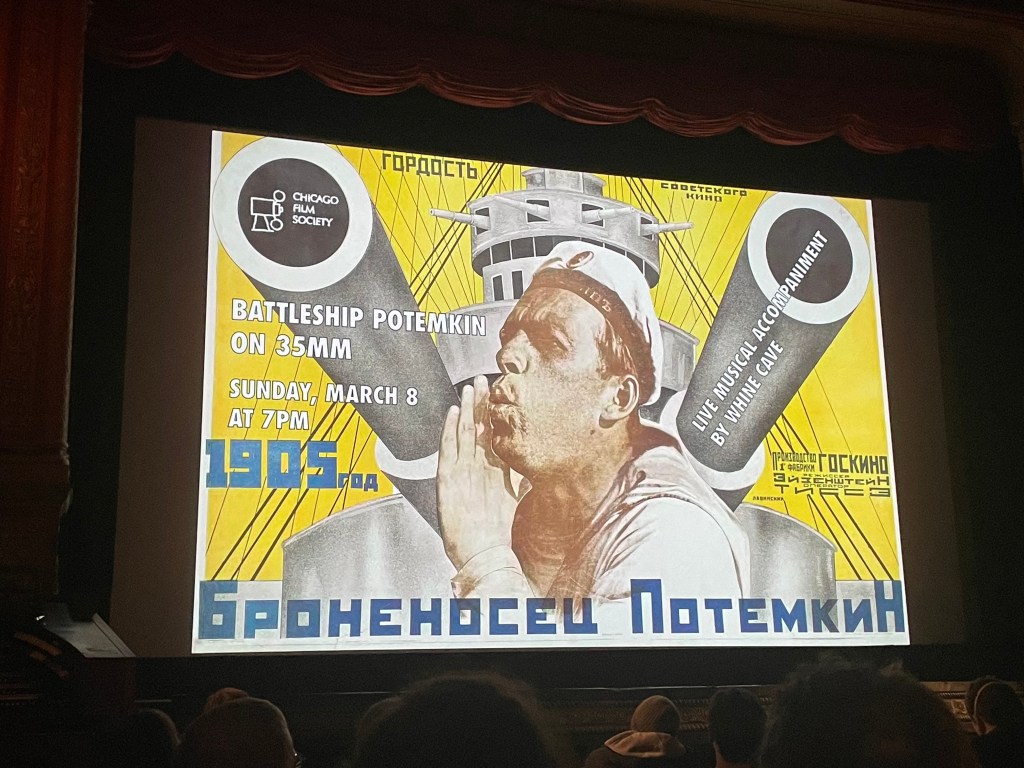
Mitch and I take turns playing the straight man and the comic. Last night, The Chicago Film Society had a slideshow before the movie, promoting their upcoming films for the season, one of which was for Sergei Eisenstein’s Battleship Potemkin.
“Did you know 1925 Soviet audiences ran out of the theater because they thought the baby carriage was coming at them?” I asked.
I thought he was going to tell me that accounts of people running from projections of oncoming trains were most likely apocryphal stories spread by early 20th century marketing folks, but instead he said, “That poster was totally made with AI — look at that unreadable text!”
He won that round.
 Parklife